The Most Important Thing in Venture
One of my favorite books on investing is The Most Important Thing by Oaktree co-founder Howard Marks. The title is a play on how, in meetings with Oaktree clients, Marks would find himself saying “The most important thing is X,” and then ten minutes later, “The most important thing is Y.” The book spends a chapter on each – 20 “most important things” in all. Some mostly apply to public markets, like market efficiency and being attentive to cycles, but others, like second-level thinking and contrarianism, apply to any kind of investing.
I thought it would be fun to apply the format to venture investing and lay out the principles I’d use when deciding whether to invest in or work for a startup.
I’ll start with the “most important things” that I think are least obvious.
Storytelling
I joined Andreessen Horowitz to build its Profile of the Future series in part because I think helping companies tell better stories matters far more than most people realize. As Ben Horowitz put it:
“Storytelling is the most underrated skill… The story must explain at a fundamental level why you exist. Why does the world need your company?... You can have a great product, but a compelling story puts the company into motion. If you don’t have a great story it’s hard to get people motivated to join you, to work on the product, and to get people to invest in the product… The mistake people make is thinking the story is just about marketing. No, the story is the strategy. If you make your story better you make the strategy better.”
Sequoia founder Don Valentine puts it more bluntly to a room of Stanford GSB students: “The art of storytelling is incredibly important… because that’s how the money works!”
I saw this at my own startup. The essays I wrote – Why Reading is Important, How Perch Will Make Reading Free, and The Future of Books – were invaluable assets for recruiting our early team, and the writing process itself helped me clarify my thinking around the company’s strategy and why what we were doing was worthwhile.
I’ve now seen it firsthand at much larger companies too. SpaceX used the profile I wrote with Marc Andreessen, SpaceX & the Sentient Sun, to recruit engineers to xAI. And Databricks used the profile I wrote with Ben Horowitz, Databricks & the Future of the Firm, to explain what it does to customers – the CEO of Snowflake even felt the need to respond to it!
I don’t think it’s a coincidence that many of the best founders, from Elon Musk and Steve Jobs to Palmer Luckey, are excellent storytellers. Luckey goes as far as to say most of his success can be attributed to marketing. “If you want to take a really cynical view of my career,” he said, “it’s that I primarily accomplished marketing better than anyone else. With Oculus, we did a lot of great technical stuff, but I think the biggest thing we did differently was figure out how to make VR appealing to people… Marketing is not just about your end user. It’s about all the people you need to work with… [At Anduril], you’re marketing to people you need to recruit – that’s the #1 audience – and your other audience is politicians. And third is your actual customers.”
Tony Fadell dedicates a whole chapter of his book Build to storytelling. He argues that the product is downstream of the story, and that one reason the iPhone was so successful was Steve Jobs’s constant work on its story. “He’d been telling a version of that same story every single day for months and months during development–to us, to his friends, his family. He was constantly working on it, refining it,” Fadell writes. “Every time he’d get a puzzled look or a request for clarification from his unwitting early audience, he’d sand it down, tweak it slightly, until it was perfectly polished. It was the story of the product. And it drove what we built. If part of the story didn’t work, then part of the product wasn’t going to work, either, and would need to be changed.”
If a founder can’t clearly explain what they do and why, they’ll struggle to recruit, sell, and raise money. A muddled story also usually means muddled thinking, which shows up in the product and the execution. As Sam Altman puts it, “clarity of thinking, speed, and quality of execution are all linked.”
Stepping Stones
Paul Graham has a great talk where he argues that founders shouldn’t try to be visionaries. “The popular image of the visionary is someone with a precise view of the future, but empirically, it may be better to have a blurry one,” he posits. That sounded wrong to me the first time I listened to it. Aren’t the best founders visionaries?
But if you read about how the great companies actually got started, you realize what he’s getting at. Bill Gates started Microsoft by writing a BASIC interpreter for a hobbyist computer. Mark Zuckerberg built a directory for Harvard students. Apple sold just 200 computers in its first year, mostly to hobbyists. Yahoo started as a web directory at Stanford. eBay’s first customers were collectors trading Pez dispensers and Beanie Babies. PayPal initially served eBay power sellers. Oracle’s first contract was a database for the CIA, and Larry Ellison’s original goal was to build a company of 50 people he enjoyed working with. None of these founders knew how big their companies would get. They just knew they were onto something.
Graham’s explanation for why companies must start this way is that big ambitions take a long time to realize, and the further out you forecast, the more likely you are to be wrong. So rather than planting a flag at some fixed destination far in the future and calling it your “vision,” the way we imagine visionaries do, he urges founders to model themselves after Columbus, who just thought, “there’s something to the West,” and sailed west. Start with something modest that demonstrably works, and “move westward” when an opening appears.
This is a useful model, but incomplete. Starting small explains how these companies began, but not where their biggest wins came from, or why they were the ones in position to catch them.
Most of Nvidia's revenue came from graphics chips for gamers. But in 2006, years before deep learning took off, Jensen Huang launched CUDA so developers could use Nvidia’s GPUs for more than graphics, and he kept investing in it even though few people used it at first. Then, when AlexNet was trained on two Nvidia gaming cards in 2012, GPUs and CUDA became the foundation of deep learning.
OpenAI couldn’t figure out how to turn GPT-3 into a product, so it released it as an API and watched what people did with it, which is how it came up with the idea for ChatGPT.
Even Elon Musk didn’t plan for Tesla to become an autonomy and robotics company, but millions of Teslas on the road collecting driving data put it in a position to become one.
And while Jeff Bezos always intended to sell more than just books (he was following Sam Walton’s playbook, and named Amazon after the world’s largest river because he wanted to build the world’s largest store), he didn’t foresee that the infrastructure Amazon built to run its own store would become AWS, which now produces most of Amazon’s operating profit.
None of these breakthroughs were planned, but they weren’t pure luck either. Each company built something that gave it a bigger “luck surface area” and the ability to move fast when an opportunity appeared.
AI researchers Kenneth Stanley and Joel Lehman offer a more complete explanation than Graham in their book Why Greatness Cannot Be Planned. Their argument is that plans into the future aren’t just likely to be wrong, but that aiming straight at an ambitious goal is often the worst way to reach it, because the required “stepping stones” along the way rarely resemble the goal. Nobody trying to build a better oven would have started with military radar, yet that’s where the microwave came from. Evolution works this way too. Dinosaurs evolved feathers to stay warm, long before their descendants used them to fly.
Stepping stones are also why the consensus is so often wrong. Everyone extrapolates the past or judges an idea against the same visible goal, so the stepping stones to really ambitious outcomes often look like detours. Or as Steve Jobs put it, “you can’t connect the dots looking forward; you can only connect them looking backwards.”
The advice Stanley and Lehman draw from this is a kind of “novelty search” – follow novelty and interestingness like a treasure hunter rather than setting ambitious goals or planning too far ahead, and collect stepping stones that seem interesting. Taste for interestingness probably matters a lot here.
This seems to contradict the last section. Isn’t a great company story exactly the kind of “clear view of the future” Graham warns against? I don’t think so because the best company stories point in a direction rather than a destination, and the direction gets bigger as the company collects stepping stones. SpaceX’s mission was Mars, and when it absorbed xAI this year, it became “scaling to make a sentient sun.” Tesla’s went from sustainable transport to sustainable energy to “sustainable abundance,” and Musk changed that to “amazing abundance” last December. A great story is Columbus’s “there’s something to the West,” told well enough to get great people on board.
Then you move toward it one step at a time. SpaceX didn’t start with Starship. They built the Falcon 1, then the Falcon 9, then figured out reusability, then Starlink, and only now – two decades later – are they doing Starship. Getting to Mars had to be an iterative process. “This is actually a really important lesson for entrepreneurs,” Trae Stephens says, and it’s how he and his co-founders built Anduril. “We wanted to build something that we could get deployed into the field in six months or less,” he says, which is why Anduril’s first product was Sentry, a simple surveillance tower, and only once that worked did the company take on harder things, like drones and autonomous fighter jets.
Another way to think about tackling ambitious problems iteratively is the “Onion Theory of Risk,” which Marc Andreessen learned from Benchmark co-founder Andy Rachleff. On day one, a startup has every kind of risk: founding team risk, product risk, technical risk, cost of sales risk. “The way I always think about running a startup is also the way I think about raising money,” Marc says. “It’s a process of peeling away layers of risk as you go.” It sounds obvious, but Marc contrasts it with what a lot of founders do instead, which is raise as much money as possible, build fancy offices, hire as many people as they can, “and just kind of hope for the best.” Systematically removing all the risks that could kill your company is one of the best ways to get lucky.
For venture investors, the implication is to discount the TAM slides in a founder’s pitch deck and look for companies that are systematically derisking the business and collecting interesting stepping stones – hard-won capabilities, domain expertise, and assets a company is accumulating that may open doors to new, larger markets. In financial terms, stepping stones are a lot like call options, and the best companies are constantly minting new ones.
SpaceX is the best example. Cheap launches made Starlink possible, and Starlink’s revenue now helps pay for Starship. Each new stepping stone has let SpaceX deploy vast amounts of capital at returns unavailable to anyone else, and it keeps minting new ones. The ability to put mass in orbit more cheaply than anyone else may eventually lead to everything from asteroid mining to manufacturing solar panels from lunar regolith and launching orbital data centers from a mass driver on the moon. The casting expertise the company developed for its Raptor engine became another stepping stone that could let it solve the blades-and-vanes bottleneck for gas turbines and bring compute online up to 18 months faster than anyone else.
The smartest people in AI seem to think about frontier models the same way. OpenAI’s former head of research Bob McGrew describes the company’s investment in frontier models as “an option on the valuable places in the application layer.” ChatGPT was one application. Codex is another.
The opposite of investing in stepping stones is TAM conservatism. My favorite example is Uber. In 2014, after Uber raised money at a $17 billion pre-money valuation, NYU professor Aswath Damodaran said it was worth only $5.9 billion. He cited a $100 billion global taxi and limousine market and said Uber’s share was unlikely to exceed 10%.
Bill Gurley’s response, “How to Miss By a Mile,” argued that the historical taxi market was the wrong anchor. When you dramatically improve an offering and enable new use cases, “you can materially expand the market in the process.” He cited a 1980 McKinsey forecast of 900,000 U.S. cell phone subscribers by 2000. The actual number was 109 million.
As Box CEO Aaron Levie, whose humor I quite enjoy, puts it: “Sizing the market for a disruptor based on an incumbent’s market is like sizing the car industry off how many horses there were in 1910.” More recently, you’ve seen people criticizing Warhound’s $1.2 billion valuation because the TAM for police and military dogs is only about $50 million. While we can debate the merits of the exact dollar amount, it’s silly to reason about the valuation solely by the size of a beachhead market that is likely a valuable stepping stone to other applications for genetic engineering.
Another interesting implication of this way of looking at the world is that, similar to divergence in evolution, there doesn’t seem to be a limit to how many new markets can be created, and how much prosperity each of those markets can create. With enough talent, intelligence, and capital, the goods and services founders can create are seemingly infinite.
In short: if greatness can’t be planned, investors shouldn’t try to plan it either. Look for companies with a very high rate of progress that are collecting stepping stones no one else has, and where each step peels away a layer of risk. And back founders who have taste for interesting problems and can leap from one promising stepping stone to the next.
Talent
Peter Thiel says every startup has to be able to answer one question: why would the 20th employee join?
The 20th employee won’t get the equity or prestige of the founding team, so a great company needs another reason for the best people in the world to join. Thiel thinks the best answer is some version of: this is the only place in the world where you can work on this incredibly important problem.
But why stop at the 20th employee? Can you imagine this being an exciting company to join as the 10,000th employee? That’s a much harder test to pass. I can only think of a handful of companies I’d want to join as the 10,000th employee – SpaceX, OpenAI, Colossal Biosciences, Anduril – and the shared traits between them are interesting. Not only are they working on incredibly important problems, but the problems are at the edges of frontiers that are seemingly infinite and unexplored. And like Bell Labs, they’ve become Schelling points for the most talented people in their fields.
Of course, none of these companies looked like this when they started. But even early on, each was close to the only place you could work on that impossibly ambitious problem. OpenAI was the only lab besides DeepMind taking AGI seriously, and SpaceX was one of the only places you could build rockets outside the defense primes.
So the heuristic I’d use to identify truly outlier companies is: If I could only work at one company for the next ten years, would this be one of them, even as employee #10,000? It’s a stricter test than “will the next round be up,” because it makes you weigh the people, the mission, and the markets the company can expand into over a decade. It’s also probably the test the best candidates are running. If a company doesn’t pass it for me, it probably won’t pass it for the people it most needs to hire.
Another test I’d run when assessing a company is to meet as many of its people as I can. One of the lessons Joe Lonsdale took from Peter Thiel that I like is to use small details as indicators of a larger truth. How capable or hardworking one person is tells you a lot about a group. I’ve found this to be true in practice, and if I meet ten people at a company and one of them isn’t very impressive, I wouldn’t ignore it. If the team was truly great, that person wouldn’t have been allowed in. “The neatest thing that happens when you get a core group of ten great people,” Steve Jobs observed, “is that it becomes self-policing as to who they let into that group.”
Finally, watch where the talent is flowing. Which companies are the smartest young people trying to join, and what are they working on? This can be self-fulfilling, since it is often the smart young people who create the breakthroughs. In his book Liftoff, Eric Berger tells the story of a space engineering professor who made a list of the 10 best students he had ever taught. To his surprise, five were working at SpaceX before it was successful. When he asked them why, they said it was because they believed in the mission, and many of them even took pay cuts to do so. When word of this made its way to Elon Musk, he requested a meeting with the professor and asked him one question: “Who were the other five students?”
The professor later reflected on how SpaceX won the battle for talent. “I was a little bit nervous about betting on the immediate success of Falcon 9,” he wrote. “But in the long run, talent wins over experience and an entrepreneurial culture over heritage.”
Founders
When you read the biographies of great founders, it’s clear there’s no one-size-fits-all archetype. I’ve also observed that many of the best VCs look for different things. Keith Rabois looks for founders who are best in the world in some dimension – the smartest, the most tenacious, the most strategic, the best at sales – and asks, “Is there a non-zero chance that this person can change a vertical or the world?” Sam Altman says he could decide on a company for Y Combinator after a ten-minute interview by asking himself, “Does this person have the potential to be the next Mark Zuckerberg?” Doug Leone looks for founders who haven’t taken traditional paths, have deep domain expertise, and are solving their own problem. Elad Gil looks for founders that fall into one of three buckets: polymathic hyper-intellectuals like the Collisons and Larry Page, “hardcore” founders like Travis Kalanick and Elon Musk, and founders who are early to a network-effects business.
But if you read about Jack Dorsey in Hatching Twitter, for example, it’s clear that even after founding Twitter, he looked nothing like Mark Zuckerberg, who famously joked that Twitter was a “clown car that fell into a gold mine.” And I’m not sure I’d put Dorsey in either of Elad’s first two buckets.
There definitely seem to be commonalities, though. If I had to boil it down to five traits I’d look for in a founder I was considering joining or investing in, the list would be:
#1 Determination
In his essay How To Do Great Work, Paul Graham has a great line on hard work: “it may not be possible to prove that you have to work hard to do great things, but the empirical evidence is on the scale of the evidence of mortality.”
I can’t think of many founders who weren’t extremely determined, at least in the early days. Bill Gates claims he never took a single day off in his twenties, including holidays and weekends, while building Microsoft. In The Nvidia Way, Tae Kim describes how Jensen Huang routinely worked from 9:00am to midnight, and everyone worked Saturdays. Employees sometimes complained about the long hours, to which Jensen replied, “People who train for the Olympics grumble about training early in the morning, too.”
Elon Musk offers an obvious, first-principles explanation for why hard work is a prerequisite for building a great company. “If somebody else is working 50 hours a week and you’re working 100,” he explains, “you’ll get twice as much done in the course of the year as the other company.” This is especially true if you believe applied effort has a convex output curve.
But it’s not just long hours. I’m also hard-pressed to think of a great company that didn’t look like it was going to fail at some point and where the expected value of continuing to work on it looked negative. Nvidia’s first chips were built on the wrong architecture, and the company probably would have died if Sega’s CEO hadn’t invested $5 million, which bought it six months to build the Riva 128. In 2008, with Tesla and SpaceX on the verge of bankruptcy, Elon Musk put every dollar he had left from PayPal into them, even though it seemed likely that they both would still fail. For the better part of a decade, both NeXT and Pixar were failing while Steve Jobs poured in more and more of his own money, to the point where it looked like he would eventually squander the whole fortune from his first stint at Apple.
This is ultimately why Sam Altman, who watched thousands of founders go through Y Combinator, thinks determination matters above all else. “So much of being a successful entrepreneur is just not giving up,” he says. “When we have funded people who had a great idea, perfect background on paper, a great product, and it still failed – it has usually been that they’re insufficiently determined. I think this is the most important, non-obvious skill of a founder.”
People have different names for it – determination, relentlessly resourceful, grit – but you’re looking for a founder who will always figure it out and never give up.
#2 Domain Expertise
I really like Paul Graham’s advice to students who want to start a startup: just learn. “The component of entrepreneurship that really matters is domain expertise,” he says. “Larry Page is Larry Page because he was an expert on search” – not because he was an expert in “entrepreneurship” or “business.” And Page became an expert on search because he was genuinely interested in it. “At its best, starting a startup is merely an ulterior motive for curiosity,” Graham says.
I can’t think of many great founders who weren’t domain experts in what they were building. Jensen Huang spent almost a decade at AMD and LSI Logic before starting Nvidia, which is how he met his technical co-founders, Chris Malachowsky and Curtis Priem. Demis Hassabis spent almost two decades on AI, simulation games, and cognitive neuroscience before co-founding DeepMind. Jack Dorsey had been thinking about status updates (the core product hook for Twitter) since he started writing dispatch software for couriers and taxis as a teenager. Marc Andreessen built Mosaic before he started Netscape. Ryan Peterson worked on ImportGenius for years tracking international shipping before founding Flexport. Even Blake Scholl, who had an e-commerce background, became more knowledgeable about the impediments to supersonic flight than most aerospace experts he met before starting Boom Supersonic.
There’s a mythology in startups that ideas arrive like magic or people stumble into them. But as Chris Dixon and Balaji Srinivasan capture in their concept of the idea maze, the best founders have spent years mapping the maze of the problem they are solving – the paths that could work, the dead ends others have hit, and how new technology might move walls. “A bad founder,” Balaji writes, “is just running to the entrance of (say) the ‘movies/music/filesharing/P2P’ maze or the ‘photosharing’ maze without any sense for the history of the industry, the players in the maze, the casualties of the past, and the technologies that are likely to move walls and change assumptions.” The best founders have detailed answers on every one of these fronts because they’ve been chewing on some version of the problem for years.
Assessing domain expertise is also key to identifying what Marc Andreessen calls “fake founders.” He recommends using the same technique homicide detectives use to determine if a suspect is innocent – keep asking increasingly detailed questions. Fake founders can give you “a conceptual theory,” but “as they get into the details, it just fizzes out.” The founders you want to back, he says, have spent “five or 10 or 20 years obsessing on the details,” and know far more about their problem than you ever will.
#3 People follow them
Part of this is storytelling, charisma, intelligence, and credibility, and Steve Jobs, with his “reality distortion field,” is perhaps the canonical example. The easiest evidence is who has already followed them.
But just as important is acting like a leader. Elon Musk told Walter Isaacson that one of his takeaways from reading about Napoleon was that troops did better when they saw their general on the battlefield. “Armies that win have the general at the front lines, nobody wants to bleed for the prince in the palace,” he wrote recently. During Tesla Model 3 “production hell,” Musk slept on the factory floor for this reason. “That made a huge difference, and they gave it their all.”
Could you see the founder you’re thinking of backing or joining do this?
#4 Rate of Learning
John Collison once told a story about Magnus Carlsen winning a chess trivia contest. “I don’t think it’s a coincidence that the world’s number one player has also studied the most about chess history,” he said. As Stripe grew from two people to thousands, the Collisons spent a lot of time studying how other companies handled each stage. “Not that you want to blindly emulate them,” John clarifies, “but you should at least understand them.” He also thinks founders should learn the top mental models from each function – engineering, product, sales, finance. “I don’t see how you could be that effective without being pretty curious on how to learn the most important mental models,” he says.
Drew Houston offers similar advice. “Your job as CEO changes every six months,” he says, describing how he went from coding the first version of Dropbox himself to managing an organization with thousands of employees. “Reading was probably the single most valuable thing that I did.”
You see this pattern over and over with the best founders. After Nvidia’s first chip turned out to be a dead end, Jensen Huang bought about $200 worth of OpenGL textbooks and studied them with his engineers to learn a completely new approach, which led to the RIVA 128. When Facebook started breaking under its own growth because new engineers were querying the database directly instead of going through the API, Ben Horowitz asked Mark Zuckerberg how he was training them. Zuckerberg didn’t know this was something he was supposed to be doing, but he became what Ben describes as “a phenomenal student of management,” and Facebook built its legendary six-week Bootcamp that every new engineer had to go through.
In fact, Zuckerberg optimized his whole company for the rate of learning. “Companies are learning organisms,” he says. “In a lot of ways building a company is like following the scientific method – you try a bunch of different hypotheses, and if you set up the experiments well, you learn what to do.” News Feed started as a test of one of those hypotheses, after the early Facebook team noticed users clicking on friends’ profiles to see what had changed. “I define our strategy as: If we can learn faster than every other company, we’re going to win,” Zuckerberg says. “We’re going to build a better product than everyone else because we’re going to get it out first, we’re going to have a good feedback loop, and we’re going to learn what people like better than other people.” I think Meta’s rate of learning is one of the reasons it has been so good at getting from one stepping stone to the next over the last two decades.
Elon Musk gives a good first-principles explanation. “For any technology endeavor, the pace of progress is determined by how many iterations you can do, and how much progress you can make between those iterations,” he says. This is an important distinction – learning is more than reading. You need contact with the real world too. Books are a good source of hypotheses, but you must test them to know you’re actually learning and making progress.
On a long enough time horizon, someone with a higher slope ends up ahead of someone with a higher y-intercept, and that’s true of both founders and their companies. Looking at slope also keeps you from ruling out founders who are inexperienced or unpolished. “If you look at a founder who comes to meet you for a seed round, compare that founder to Brian Chesky, you will be disappointed 100% of the time,” Sam Altman says. Instead, “you should look at the growth rate of the founder… Humans always underestimate exponential growth.”
So a perhaps variation of Altman’s YC interview question applies here: is this founder as fast a learner as Mark Zuckerberg?
#5 The Right Motivations
A lot of people start companies because they think it’s a way to get rich quickly. It usually isn’t, and those people never seem to be the ones who build massive companies. For anyone talented enough to build a great company, there are far easier ways to make money, and if a financial motivation is all that’s sustaining you during what’s usually years of struggle and below-market pay, you will probably give up.
Of course, I don’t believe every great founder is altruistically driven by the mission they espouse. For many, it’s probably some combination of insecurity, curiosity, and a desire to do something important. Walter Isaacson, who has written biographies of Benjamin Franklin, Albert Einstein, Steve Jobs, and Elon Musk, wonders “whether having a lot of demons from childhood gives you a lot of drive.” Musk, Franklin, and Einstein, he points out, all ran away from home when they were teenagers. Steinbeck seemed to think so too. In East of Eden, Adam Trask’s favored son, Aron, “was content to be a part of his world, but Cal must change it.”
Steve Jobs seems to have been driven, at least in part, by restlessness, which Isaacson traces to Jobs feeling “abandoned but chosen” as an adopted child. Brent Schlender describes it in Becoming Steve Jobs: “Restlessness is far more important and powerful than simple ambition or raw intelligence. It is the foundation of resilience, and self-motivation. It is fueled by curiosity, the ache to build something meaningful, and a sense of purpose to make the most of one’s entire life.” And as Larry Ellison observed, we humans “love to test ourselves constantly, and we find all sorts of arenas to test ourselves in.” He goes as far as to suggest that most overachievers are driven less by the pursuit of success than by the fear of failure. “Whenever I feel even remotely close to being at risk of failure, I can’t stop working,” he says.
Notice that none of these motivations is money.
The motivation I find purest, though, is that they just love the work. “The only way to do great work is to love what you do,” Jobs said in his Stanford commencement address. And his favorite interview question was: “What are you so passionate about that you’d do it for free?”
It was Steve Wozniak who instilled in Jobs the belief that loving what you do was the best predictor of future greatness. Before Apple, Woz spent countless nights in his garage building computers simply because he loved it. In high school, he told his father that someday he would have a computer of his own. “Well, Steve,” his dad said, “they cost as much as a house.”
“Well, I’ll live in an apartment,” Woz answered.
That’s what you’re looking for.
How do you test for it? I like Marc Andreessen’s proxy of curiosity. “Curiosity is a proxy for, do you love what you do?” he writes in How to Hire the Best People You’ve Ever Worked With. “Anyone who loves what they do is inherently intensely curious about their field, their profession, their craft. They read about it, study it, talk to other people about it… In my experience, drive and curiosity seem to coincide pretty frequently. The easiest way to be driven is to be in a field that you love, and you’ll automatically be curious.”
Strategy
We discussed strategy a bit in Storytelling, but what exactly separates a good strategy from a bad one? A good book on the topic is Good Strategy Bad Strategy by Richard Rumelt. Rumelt’s central claim is that good strategy has three parts:
- A diagnosis of the situation that simplifies a messy situation into a story people can act on
- A guiding policy that channels effort without spelling out every step
- A set of coherent actions that carry out the policy
Bad strategy, on the other hand, fails to face the actual challenge, lacks focus, and often mistakes goals or wishful thinking for strategy.
The book can be monotonous at times, with a lot of academic jargon and case study after case study. But a few of its ideas have stuck with me because I keep seeing them in the best companies.
Strength against weakness. The most basic idea in strategy is to apply your strength against an opponent’s weakness. The canonical example is David and Goliath – David refused Saul’s armor because he couldn’t move in it and fought Goliath from a distance with a sling, so the giant’s size never came into play. A good business example is Intel. By the mid-1980s, memory chips had become a commodity and the advantages that mattered were manufacturing yield, cost, and capital, which is exactly where Intel’s Japanese rivals were strongest. Intel’s strength was chip design. It had designed the microprocessor inside the IBM PC, and a fast-growing library of PC software was written for that chip’s architecture. When Andy Grove asked Gordon Moore what a new CEO would do if the board replaced them, Moore said, “He would get us out of memories.” So that’s what they did. In 1985, Intel left memory to focus on microprocessors, and it stopped licensing its designs to second-source manufacturers like AMD to protect its advantage. It was painful – they laid off almost one third of Intel’s workforce – but it’s ultimately how Intel became one of the most important companies in the world.
Focus. For Rumelt, focus isn’t just picking a niche. It means two things at once: policies coordinated so they reinforce each other, and that combined power aimed at the right area. The best example is probably Amazon. Jeff Bezos built the company on three coordinated policies – low prices, fast delivery, and vast selection – and started with books because that’s where vast selection mattered most. There were more than 3 million books in print, which was far more than any other category and far more than any store could stock. He also chose those policies because they wouldn’t change. “You can build a business strategy around the things that are stable in time,” Bezos says. “It’s impossible to imagine a future ten years from now where a customer comes up and says, ‘Jeff, I love Amazon, I just wish the prices were a little higher.’ Or, ‘I love Amazon, I just wish you’d deliver a little slower.’ Impossible.”
Proximate objectives. This is Rumelt’s term for turning an overwhelming goal into a problem a team can actually solve. When a goal is too ambiguous, people get confused and can’t see how their work fits into it, which hinders coordinated action. In 2006, a mass-market electric car was a lofty, impossible goal, but Elon Musk broke it down into objectives a small startup could actually hit in his “Secret Tesla Motors Master Plan.” Tesla would “enter at the high end of the market, where customers are prepared to pay a premium,” then “drive down market as fast as possible.” At the end of the post, he summed up the company’s entire strategy in four steps:
- Build a sports car
- Use that money to build an affordable car
- Use that money to build an even more affordable car
- While doing above, also provide zero emissions electric power generation options
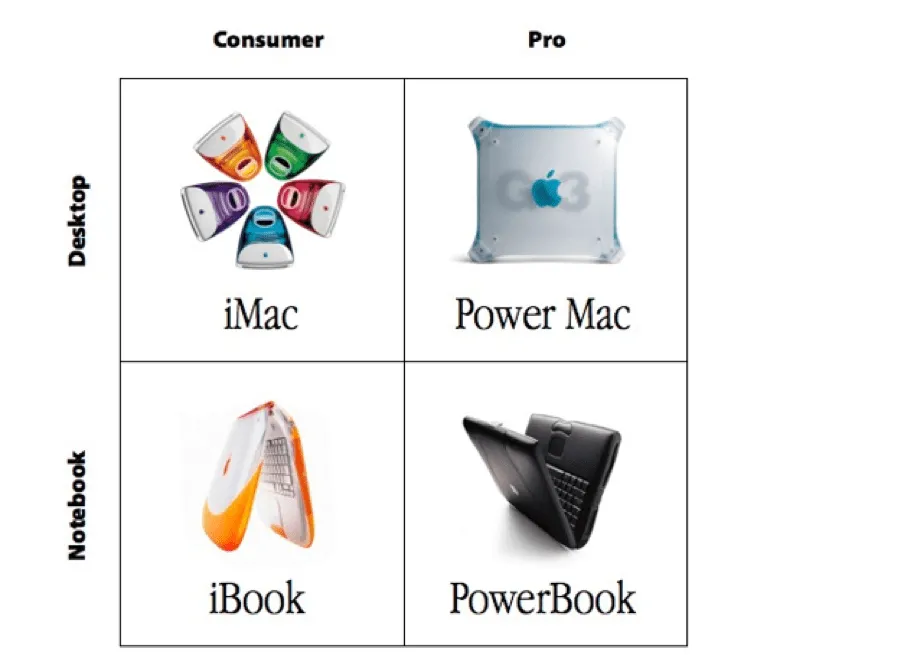
Steve Jobs’s return to Apple exemplifies all three ideas at once: strength against weakness, focus, and proximate objectives. Apple was making far too many products at the time, and Jobs cut them down to four, drawn as a simple two-by-two matrix: a desktop and a laptop, each for consumers and for professionals. Anyone at the company could understand it, which made it a proximate objective. It concentrated Apple’s resources in a few great products that reinforced each other, which is focus. And it put Apple on the opposite course from Windows PC makers, who competed on price with a sprawl of interchangeable machines, by aiming at the high end of the market where Apple’s design was strongest. Fewer products meant more efficiency at premium prices, and Apple went from losing more than $1 billion in 1997 to making a profit the following year.
Chain-link systems. If you ask a founder, “What’s the one thing that’s limiting your rate of growth right now?” they’ll usually tell you that there are many things. But that’s not true. By definition, there is one thing in any system that limits the rate of progress for the whole system, which is called the “bottleneck.” Once you identify the bottleneck, the highest leverage thing you can do is increase its throughput. This is another thing Elon Musk does exceptionally well. “Basically what Elon does,” Marc Andreessen explains, “is he shows up every week at each of his companies, identifies the biggest [bottleneck] and he fixes it. He does that every week for 52 weeks in a row.” Every founder should be able to tell you what their bottleneck is right now and what they’re doing to increase its throughput.
Using dynamics. The biggest opportunities come from riding a wave of change, like a new technology or deregulation, to new high ground. For example, Jeff Bezos started Amazon after reading that web usage was growing 2,300% a year, and Nvidia rode the deep learning wave after AlexNet. Rumelt also notes that one of the best signals for opportunity in a period of change is how incumbents respond, and you can see it happening now with AI. When Amazon started restricting AI shopping agents this fall, Paul Graham called it “the first opportunity I’ve seen since Amazon was founded” for a startup to build an Amazon competitor. Elon Musk seemed to agree.
Durable advantage. Another good book on strategy is Hamilton Helmer’s 7 Powers. Helmer argues that a lasting advantage needs two things: a benefit, and a barrier that stops competitors from copying it. He has found only seven sources of one: scale economies, network economies, counter-positioning, switching costs, branding, cornered resources, and process power. I’d look for at least one of these when assessing a founder’s strategy and what their advantage will be in five years. I won’t go into each of them here; the book is short and worth reading.
But there’s one strategy neither book focuses on that I think deserves a quick primer. Nick Sleep and Qais “Zak” Zakaria ran the Nomad Investment Partnership from 2001 to 2013 and returned 921%, compared to 89% for the S&P 500 during the same period. A core driver of these outstanding returns was that they looked for a specific type of investment opportunity that rewarded extreme patience. They called it “scale economies shared” – their term for businesses that used their growing scale to pass savings back to customers in the form of lower prices. When a company shares its savings, customers respond by buying more, which produces more scale, which produces new savings, which are passed again, and so on. The loop strengthens as the company grows because a competitor cannot match the prices without the scale and cannot get the scale without the prices. Costco and Amazon were their canonical examples. It also seems to be the core strategy and source of competitive advantage for Elon Musk’s companies, including Tesla, SpaceX, and the Boring Company.
So the questions I’d ask here are: Can the founder articulate the company’s strategy? How are they applying strength against weakness? And what will the company’s advantage be five years from now?
Preferential Attachment
Peter Thiel popularized the power law of venture capital in his book Zero to One, where he writes that “the best investment in a successful fund equals or outperforms the entire rest of the fund combined.” But few people seem to understand the dynamics that cause a small handful of companies to radically outperform all others.
Thiel opens his chapter on the power law with a verse from the Parable of the Talents in the Gospel of Matthew: “For whoever has will be given more, and they will have an abundance. Whoever does not have, even what they have will be taken from them.” The sociologist Robert Merton used the same verse to name the “Matthew effect,” which is the tendency of the rich to get richer and shows up in everything from science to fame to money. In that chapter, however, Thiel doesn’t spend much time on why it happens. He treats the power law as “the law of the universe,” like Vilfredo Pareto’s 80-20 observation, and advises founders and investors to never underestimate exponential growth and to “think hard about where your actions will fall on the curve.”
But if you understand why the power law happens, you will probably have a better chance of spotting those truly outlier companies. The two best explanations I’ve heard come from Marc Andreessen and Paul Graham.
Marc focuses on what network scientists call preferential attachment. “A startup needs to get into a loop where it’s accruing more and more resources as it goes,” he explains. “Those resources are qualified executives, technical employees, future downstream financing, positive brand momentum, public perception, customers, revenue, ability to throw weight in the government.” You need all of these to succeed, he says, and “you’re either a snowball rolling down the hill, picking up resources, gaining size and scope and scale, power, credibility as you go, or you’re not – you’re kinda stuck at the top of the hill as a snowflake and you’re just not going anywhere.”
Graham explains why loops like this produce such extreme outcomes. In his essay “Superlinear Returns,” he traces them to two causes: exponential growth and thresholds. The first is what Marc is describing. “Whenever how well you do depends on how well you’ve done,” Graham writes, “you’ll get exponential growth.” And small differences in growth rates compound into enormous differences in outcomes – after a year, a startup growing at 5% a week will be 13x bigger, while one growing at 7% will be 34x bigger.
The second cause, thresholds, creates “winner take all” dynamics. Many markets work this way, especially in tech. As Graham puts it, “If your product is only half as good as your competitor’s, you don’t get half as many customers. You get no customers, and you go out of business.” A customer usually picks one product, and an engineer can only join one company. This is why it pays to only join or invest in a startup that can be #1 in its category. Fortunately, as we discussed in Stepping Stones, a company can often leverage its unique capabilities to find a branch of the market that nobody owns yet. Anthropic focusing on enterprise and coding while OpenAI dominated consumer AI is a good example.
The two causes feed each other. Crossing a threshold leads to exponential growth, Graham observes, and exponential growth helps you cross the next threshold. But the same forces also work in reverse. A company that falls behind starts losing recruits, investors, and customers to the leader, and each loss makes the next one more likely. There’s rarely a stable middle. A startup is usually either a snowball rolling downhill or a snowflake.
So if I were evaluating a startup, I’d look for evidence of preferential attachment. Is the next resource – talent, capital, customers – more likely to attach to this company or to a competitor? Is the growth rate sustainable, accelerating or decelerating, and higher than a competitor’s? And is there a category that it can be #1 in?
Timing
The “adjacent possible” is a term coined by biologist Stuart Kauffman, originally to describe how early life could only build new molecules from combinations of those already present. Steven Johnson popularized it as a theory of innovation in his book Where Good Ideas Come From, arguing that, at any moment, the inventions within reach are the ones a step away from what already exists. Johnson compares it to a house that grows as you explore it: every room you enter has doors into rooms you couldn’t have reached before. That’s why good ideas often arrive at the same time in different places, as when Alexander Graham Bell and Elisha Gray filed telephone patent papers on the same day in 1876 or when Newton and Leibniz independently invented calculus in the late 17th century. It’s also why ideas that arrive too early fail. Charles Babbage designed a programmable computer in the 1830s, but it sat outside the adjacent possible, and the electronic computer had to wait about a century for the vacuum tube.
My favorite example is the history of glass, which Johnson tells in his later book How We Got to Now. Glasses were invented in northern Italy around 1286, but for more than 150 years, they were a niche product for monks and scholars. Then, as Gutenberg’s printing press spread books across Europe, many people discovered for the first time that they were farsighted, and demand for reading glasses surged. Spectacle makers spread across Europe, grinding and testing lenses all day, and around 1600, a few of them in the Netherlands put two lenses together to invent the microscope and the telescope. Then the adjacent possible kept expanding. Galileo used the telescope to discover moons on Jupiter and help make the case for heliocentrism, while the microscope revealed cells and bacteria, a first step toward germ theory. None of these things could have come much earlier. Those discoveries needed the telescope and the microscope, which needed lens makers, who needed customers, who needed books.
You often see the same thing in startups. Silicon Valley is full of companies that had the right idea at the wrong time. General Magic was building the iPhone in the early 1990s, but the infrastructure, hardware, and market didn’t exist to support it. SixDegrees was a social network years before LinkedIn and Facebook, but in 1997 most people weren’t online, and dial-up internet was too slow to upload photos. Webvan built its own warehouses to deliver groceries during the dot com boom but went bankrupt in 2001. A decade later, smartphones with GPS let Instacart, Uber, and DoorDash coordinate thousands of shoppers and drivers in real time. And before the iPad, there was Apple’s Newton, which flopped because mobile broadband, high-resolution screens, and good batteries didn’t exist yet.
The “curse of the entrepreneur,” Marc Andreessen believes, is being too early. “We almost never see a qualified founder fail because they were too late to market,” he says. “It’s almost always because they’re too early to market. And I don’t say that critically. When we screw up investments, I think that’s often the reason as well.”
This is why Sequoia urges founders to answer “Why now?” in their business plans. “The best companies almost always have a clear ‘why now?’” the firm writes. “Nature hates a vacuum - so why hasn’t your solution been built before now?” A good answer names something that just entered the adjacent possible, like broadband for Youtube or the 2,300% annual growth in web usage that convinced Jeff Bezos to start Amazon.
So the questions I’d ask here are: Why now? What changed recently that makes this possible, and why hasn’t it been built before? If it’s been tried before, what’s different this time? And if the company is early, can it survive until the world catches up?